1. What is AML/CTF?
AML/CTF stands for Anti-Money Laundering and Counter-Terrorism Financing
It refers to a set of laws and regulations designed to stop the illegal practice of making money from criminal activity, such as drug trafficking, fraud, or corruption, from appearing legitimate (money laundering) and to prevent the financing of terrorism.
In Australia, the primary legislation is the Anti-Money Laundering and Counter-Terrorism Financing Act 2006 (AML/CTF Act) and the AML/CTF Rules.
The AML/CTF Act currently regulates financial, gambling, remittance, digital currency exchange providers and bullion sectors that provide designated services listed in the AML/CTF Act.
The AML/CTF Act require businesses—known as ‘reporting entities’—to:
- Verify the identity of their clients (Customer Due Diligence – CDD
- Monitor and report suspicious transactions, and
- Maintain detailed records for regulatory scrutiny.
AUSTRAC is Australia’s AML/CTF regulator and financial intelligence unit.
2. Key legislative changes
The Anti-Money Laundering and Counter-Terrorism Financing Amendment Act 2024 (Cth) (the new AML/CTF Act) received Royal Assent on 10 December 2024, and it brings about significant reform to the Anti-Money Laundering and Counter-Terrorism Financing Act 2006 (Cth) and the Australian AML/CTF regime.
3. Real estate captured under the new AML/CTF Act
The new AML/CTF Act isn’t just another regulatory hurdle—it’s a fundamental shift in how real estate transactions will operate in Australia.
Real estate professionals (as well as other gatekeeper professions) that provide a designated service (defined in the new AML/CTF Act) will be regulated under the new AML/CTF Act from 1 July 2026.
From 1 July 2026, every property sale will require identity checks, source-of-funds verification, and ongoing monitoring—just like banking transactions.
From 1 July 2026, every property transaction will require:
- Identity checks
- Source-of-funds verification
- Ongoing monitoring of transactions – similar to banking requirements
New ‘Designated Service’
The reforms introduce a new designated service for brokering the sale, purchase, or transfer of real estate on behalf of a person in the course of business.
This applies to:
- Vendors’ agents – e.g., a standard seller’s agency service
- Purchasers’ agents – e.g., a buyer’s agency service
A reporting entity is any person or business providing a designated service. In most cases, the reporting entity will be the business itself, not individual employees.
The definition also captures property developers and businesses selling directly without an independent real estate agent, such as:
- House and land packages
- Off-the-plan apartment sales
- Vacant land in new subdivisions
Not included as designated services:
- Residential tenancy agreements
- Property management
- Commercial leasing
- Auctioneer services (unless conducted by the seller’s agent as part of brokering the sale)
4. Why are the changes happening?
Real estate transactions involve large sums of money, making them attractive for money laundering. Criminals may use the sector—sometimes with the assistance of professionals who are unaware of the risks—to conceal illicit funds.
These reforms close a long-standing regulatory gap and bring Australia into alignment with Financial Action Task Force (FATF) global standards.
Industry guidance: REINSW
5. Obligations from 1 July 2026
Real estate professionals involved in buying or selling residential, commercial, land, or industrial property will need to:
- Enrol with AUSTRAC as a reporting entity (enrolment opens 31 March 2026)
- Develop a business-specific ML/TF Risk Assessment
- Develop a tailored AML/CTF Program
- Appoint an AML/CTF Compliance Officer
- Train all relevant staff on AML/CTF obligations
- Conduct CDD – verify client identity before providing a designated service
- Report suspicious activity to AUSTRAC via Suspicious Matter Reports (SMRs)
- Monitor clients and transactions on an ongoing basis
- Maintain records securely for at least seven years
The AML/CTF framework is risk-based, meaning implementation depends on your unique exposure to money laundering and terrorism financing risks.
6. How to Start Preparing – suggested implementation plan
While the start date may seem distant, implementing AML/CTF compliance is complex and time-consuming. We recommend that you begin considering the required changes for your business. To assist, we have developed the following suggested implementation plan.
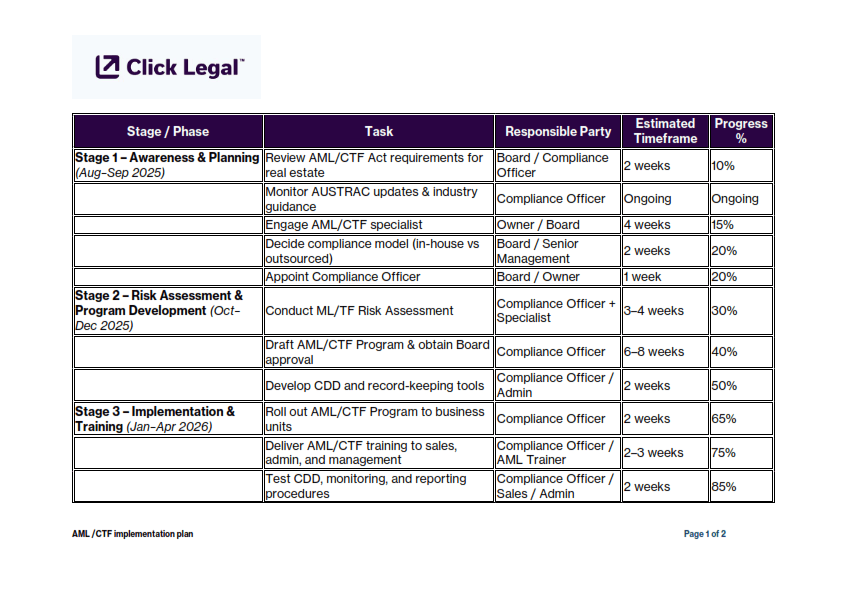
Suggested Implementation Plan – Page 1
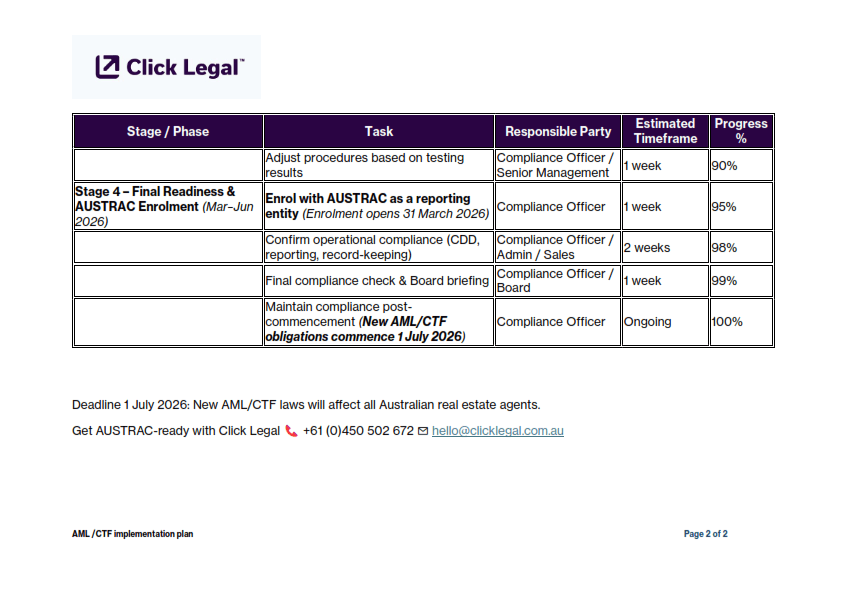
Suggested Implementation Plan – Page 2
7. Risks of Non-Compliance
From 1 July 2026, AUSTRAC has signalled that it will prioritise enforcement against entities that:
- Fail to enrol as reporting entities
- Ignore or deliberately avoid AML/CTF obligations
- Are complicit in, or wilfully blind to, money laundering
Failure to comply may result in:
- Significant financial penalties
- Reputational damage
- Enforcement action
Example: AUSTRAC has issued Australia’s largest civil penalties for AML/CTF breaches, including multi-million-dollar fines against major financial institutions.
8. How Click Legal Can Help
Click Legal delivers expert AML/CTF compliance solutions for real estate professionals—from on-demand training to fully tailored compliance program development.
Our AML/CTF services cover:
- Understanding AML/CTF legislation
- Identifying and reporting suspicious transactions
- Implementing risk-based management systems
- Protecting your agency from money laundering & financial crime
- Ensuring ongoing AUSTRAC compliance
Don’t risk non-compliance, penalties, or reputational damage
Partner with Click Legal to develop your tailored AML/CTF compliance program today and be AUSTRAC-ready before the deadline.
📞 +61 (0) 450 502 672
✉ hello@clicklegal.com.au