Breach Reporting Policy Template (ASIC | AFSL)
Aligned with RG 78 & section 912D
$249.00 +GST
Free Download for COMPASS Members
- Identify Reportable Situations against the Core Obligations and significance tests;
- Set internal reporting timeframes from detection through to determination;
- Report to ASIC within 30 days through the ASIC Regulatory Portal;
- Record every incident and breach in the Schedule 1 breach register.
Ready in Seconds
Download instantly after purchase - no waiting required
Forever Yours
Unlimited access to your documents whenever you need them
Fully Customizable
Edit to your exact needs with our user-friendly PDF format
Need more than a template?
Request your FREE consultation & our senior lawyers will contact you to discuss your situation.
About this Document
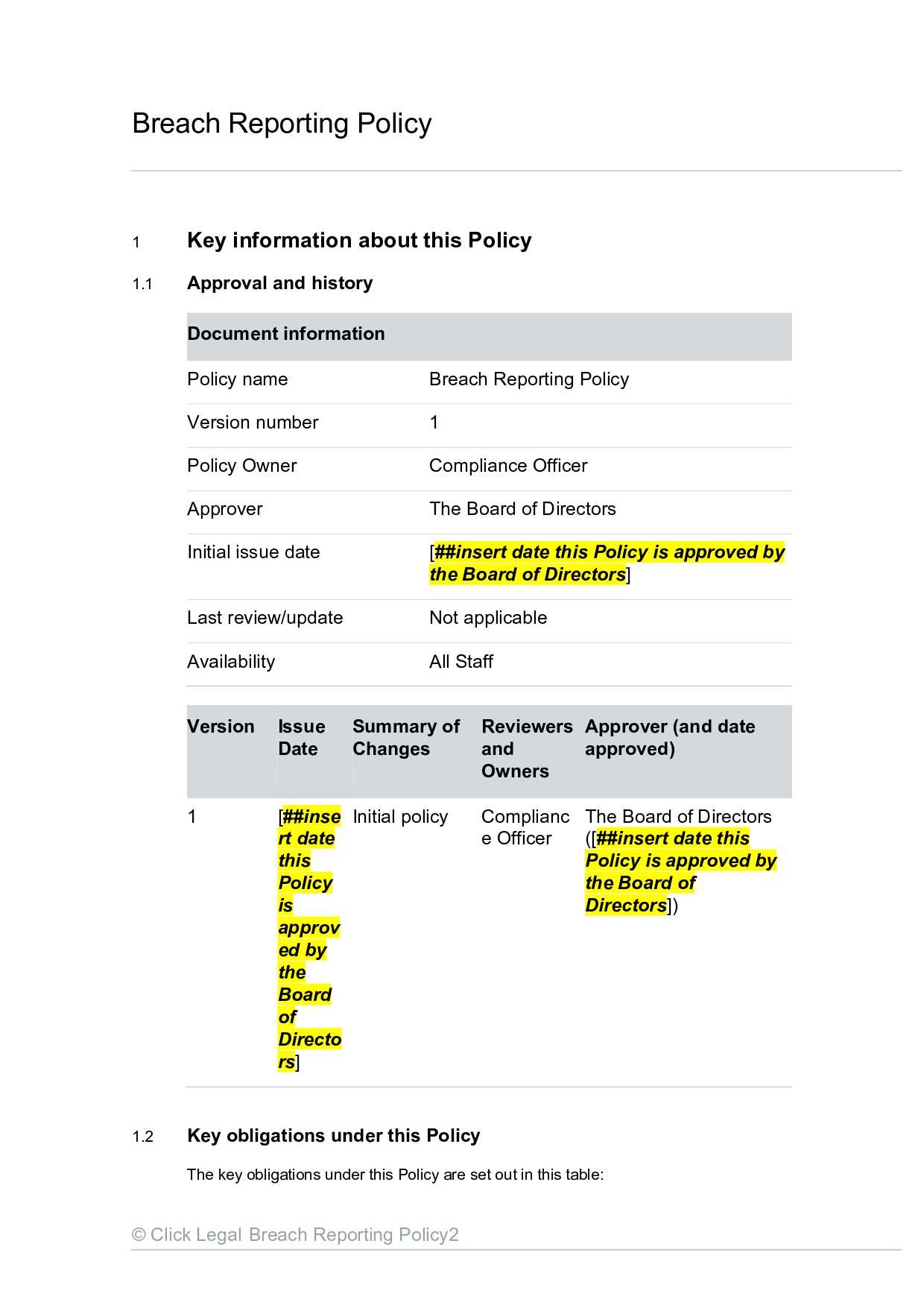
An AFS licensee must notify ASIC of a Reportable Situation within 30 days of first knowing, or being reckless as to whether, there are reasonable grounds to believe one has arisen. This template is a complete internal policy for getting there: how incidents reach the Compliance Officer, how significance is assessed, and how reports and records are made.
Use this policy if you:
- hold an Australian Financial Services Licence and provide financial services
- need a documented process for identifying, assessing and reporting breaches
- want internal deadlines that leave time to assess significance before the 30-day clock runs
- need a breach register that records incidents whether or not they are reported
- want your Compliance Officer and board to have defined roles in the process
It is suited to:
- AFSL holders with a Compliance Officer and a board of directors
- licensees acting as trustee or investment manager of managed investment schemes
- compliance teams documenting escalation and investigation timeframes
- boards reviewing Reportable Situations and rectification at their next meeting
What this policy covers:
- the types of Reportable Situation, from significant breaches of a Core Obligation to gross negligence and serious fraud
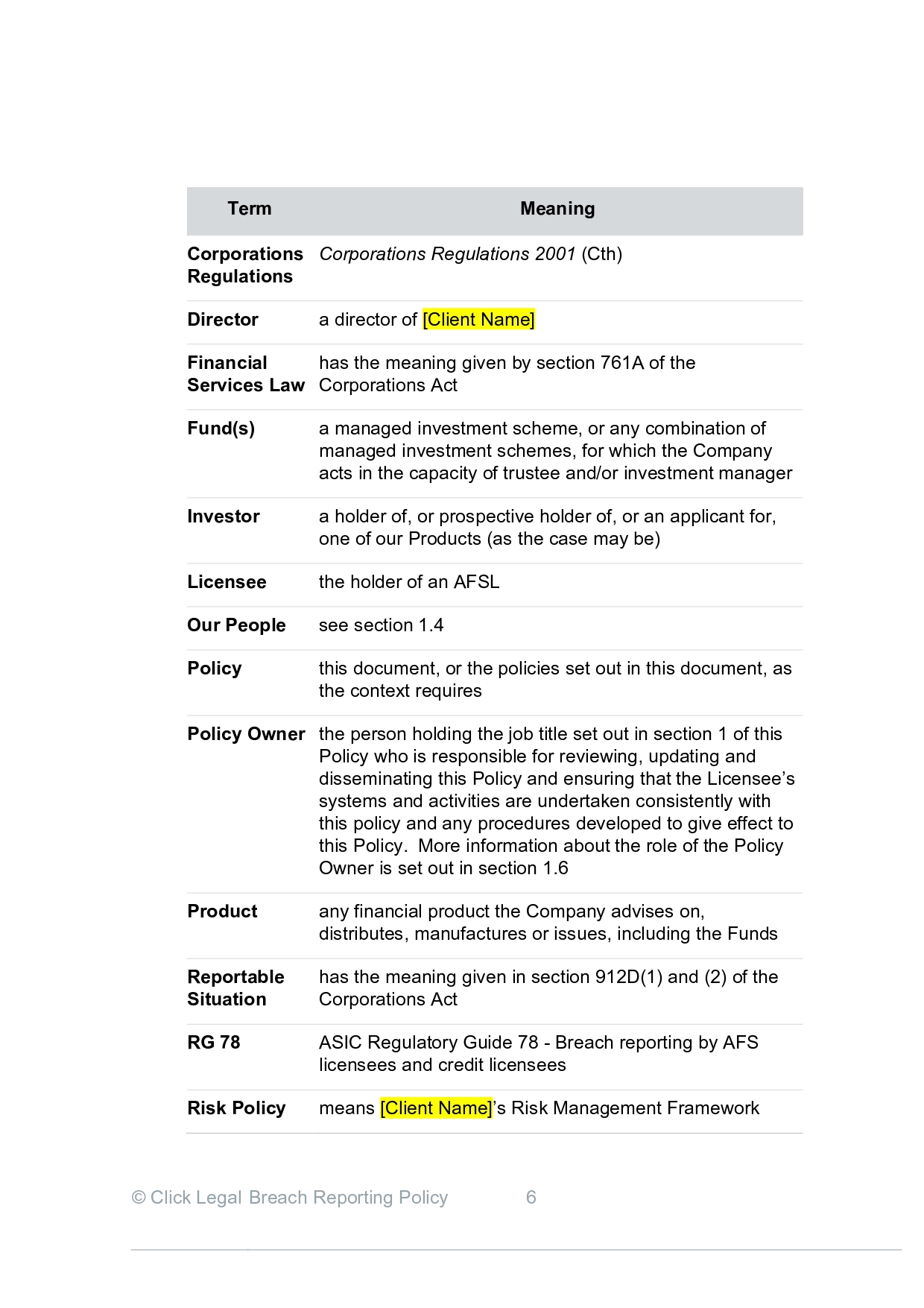
- the Core Obligations under sections 912A and 912B of the Corporations Act 2001 (Cth), and the parts of the Financial Services Law caught by section 912D(3)(b)
- the deemed significance tests, covering offence penalties, civil penalty provisions, misleading or deceptive conduct and material loss or damage
- the general significance assessment applied where no deemed test is met
- a four-step process: report to the Compliance Officer within 14 days of detection, determination within ten days, report to ASIC within 30 days, board review at the next meeting
- investigation handling, including escalation to the board after twenty-five days and the Investigation Reportable Situation that arises on the 31st day
- a key obligations table setting the timing and responsible person for each duty
- Schedule 1, a breach register covering reporting and detection dates, entities and fund or client affected, description and root cause, impact and level of risk, and corrective and preventative action
You receive an editable Word document with placeholders for [Client Name], the ACN and AFSL number, and the date the policy is approved by the board, together with a version history table and the Schedule 1 breach register. Sections 1 and 2 explain the regime and section 3 sets out the policy itself, so timeframes and role titles can be adjusted to match how your organisation operates. It is a starting point rather than advice on your licence conditions, so have it reviewed and tailored before you adopt it.
How To Use This Template
This template is a starting point, not a final document. It’s been drafted by Australian lawyers to be practical and flexible, but it still needs to be reviewed and tailored for your specific business, transaction and risk profile.
Before you use it, you should:
- Complete all placeholders, bracketed items and optional fields;
- Remove any drafting notes or clauses that aren’t relevant to your situation; and
- Check that party names, entity details, dates, addresses, contact details and defined terms are accurate.
Make sure the template is consistent with your other documents and obligations – including any existing contracts, policies, procedures, website terms, privacy disclosures, regulatory requirements or internal governance documents. If anything conflicts, it should be resolved before you sign, issue, adopt or implement the document.
If you are using the template as an agreement, it should be reviewed and signed by all relevant parties in accordance with applicable law and your internal signing requirements. If you are using it as a policy, procedure, notice or compliance record, it should be approved and stored under your organisation’s normal document control processes.
This template is provided as general information only and is not legal advice. Complex, high‑value, highly regulated or cross‑border matters will usually require bespoke drafting. For anything outside a straightforward use case, we strongly recommend obtaining legal advice before relying on, signing or implementing this document.
Step 1
Secure Your Template
Quick checkout process with instant confirmation
Step 2
Check Your Email
Your download link arrives instantly in your inbox
Step 3
Relax & Thrive
Focus on growing your business with rock-solid legal protection
What Our Clients Say About Working With Us

GUY RAVEN
Head of Surveillance Advisory, Westpac

“Hannah demonstrated exceptional leadership and regulatory expertise. She played a pivotal role in developing the control room and establishing a strong regulatory compliance framework…Beyond her deep technical knowledge, Hannah is an outstanding mentor, approachable, and insightful.”

JASON WATTS
Managing Director, Neu Capital
“Hannah blends rare regulatory expertise with sharp business acumen. As her Manager at Barclays, I watched her master APRA/ASIC frameworks and turn them into clear, actionable strategies… She’s the kind of professional who simplifies complexity, and her integrity is unmatched.”

STUART HILL
Program Manager/Operations Manager
“Hannah has exceptional depth of knowledge and expertise in building robust legal, risk, and compliance frameworks….. Beyond her technical expertise, Hannah is a strategic thinker and a genuinely kind, friendly person who always supports and helps others.”

JASON LOWRY
Co-Founder, LPG
“Could not recommend Click Legal more highly! Must have for start ups and small business owners looking to trust someone to help set up your business right!”

JASON GOLD
Managing Director, IT Pro Tech
“At IT Pro Tech, we partner with businesses who share our commitment to integrity. Click Legal stands out in the legal space for exactly that. Hannah and the team impressed us with their deep understanding of compliance-heavy sectors and their ability to offer clear, practical legal advice without overcomplicating the process.”

ANTONELLA SPATOLA
Founder, True To You Charity
“Hannah at Click Legal has supported the board in establishing our documentation and legal framework to start on a solid footing. We appreciate her authentic interest in the charity’s mission… We appreciate how she explains complex concepts in simple terms, avoiding legal jargon.”

SHARON YANG
Head of Investment & Capital Mgmt
“Hannah and Click Legal have provided reliable legal advice to us. It has been integral in helping us meet all our AFSL obligations with confidence. I highly recommend their services to any business needing compliance support.”

Freshta Mayar
Google Verified Review

“A fantastic team, very easy to work with and provide great service and advice. Hannah and her team are absolute superstars – commercial, knowledgeable and efficient.”

Shu Jen & James Benson
Asset Management
“Handled the legal admin we avoided—contracts, policies, the lot—so we could focus on growing the business.”

David Parker
Founder of Innovate Solutions Pty Ltd
“After experiencing poor advice from other lawyers, I was fortunate to connect with Hannah. She stands out with her expertise, intelligence, and entrepreneurial mindset. Hannah’s ability to navigate complex legal matters and provide actionable guidance for startups and scaling businesses is unmatched. Highly recommend her services.”

Emma Reid
Freelancer Graphic Designer

Eran Ben-Shahar
CTO, Product, Strategy, Technology | SSPG Founder

Hillier Deniz
CEO, Paragon Funds Management

Erin Sutton
Business Unit Leader

Andrew Lane
Founder Shoplab
“Startups, meet your legal dream team Click Legal. They speak your language, understand scaling businesses, and deliver founder-friendly advice that fits your growth.”

Sunita
Verified Review

COO
International Digital Asset Exchange
“Thank you for your incredible patience and dedication throughout this entire process. The level of care & attention to every detail has been truly outstanding, and Click Legal has been deeply responsive – even late at night & over weekends.”
Need more than a template?
Request your FREE consultation & our senior lawyers will contact you to discuss your situation.
Legal & Compliance Insights
Join our Newsletter
Subscribe to our newsletter for the latest legal updates, insights, and firm news delivered straight to your inbox.
CONTACT
Request A Consultation
Not sure which matter or service is right for you? Leave your details & our lawyers will contact you to discuss your situation & outline next steps.
